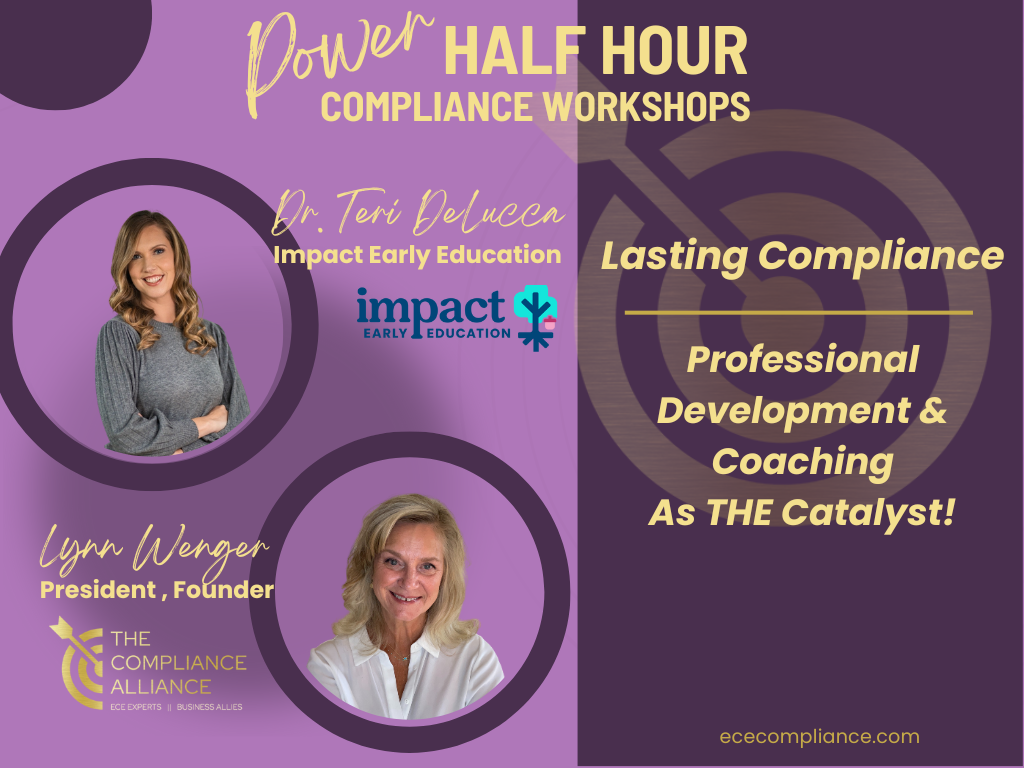
Compliance Power Half Hour with Dr. Teri DeLucca, Impact Early Education
Professional development too often lands on our to-do lists as just another compliance checkbox—especially in early education. But what if it could be your most powerful tool for building a thriving, loyal, and high-performing team?
That was the compelling message shared by Dr. Teri DeLucca of Impact Early Education on this insightful episode of the Compliance Power Half Hour with TCA host Lynn Wenger.
Professional Development Is More Than a Requirement—It’s the Pathway to Compliance and Success
Dr. DeLucca made a strong case that training isn’t just about satisfying state mandates. When it’s done well, professional development becomes a core driver of operational consistency, strong culture, and long-term compliance.
“When it becomes part of how you operate and how you think, you begin to see real change. You see staff stay, loyalty build, and classroom performance rise—kids start soaring off the charts.”
Myth-Busting: “We Don’t Have Time—or Money—for Training”
One of the most common barriers Teri and Lynn hear is lack of time and budget for staff development. Teri argues convincingly that professional development is not a luxury—it’s a necessity.
- Research shows staff are more likely to stay when they’re supported in their growth, not just trained for their roles.
- Staff engagement increases when training is paid for and completed on the clock.
- Using tools like training matrices or professional development planners makes implementation achievable, even in busy centers.
As Lynn added, “If you choose affordable, high-impact training and schedule time for it intentionally, it doesn’t have to be overwhelming or time-consuming. It can be simple and effective.”
Connection Before Correction—and the Power of Trust
Whether you’re working with children or adults, trust comes first. Dr. DeLucca emphasizes that every interaction builds or depletes the “trust bank.” Leaders who approach feedback from a place of connection and authenticity earn more buy-in and better outcomes.
Coaching Isn’t Punitive—It’s Collaborative
Another key insight: Coaching should not be seen as a disciplinary tool. It’s a partnership. When leaders approach feedback conversations as “thinking partners,” staff become more open, confident, and capable.
Lynn connected this to The Compliance Alliance’s approach:
“At The Compliance Alliance, we talk about the trifecta of compliance—having standard operating procedures, having checklists, doing audits. And if you’re training on that, like you said, it’s about supporting your growth. That becomes part of the culture.”
Be sure to check out the free Guide to One-on-One’s Here
Set the Foundation: Standards of Behavior
Dr. DeLucca shared a practical tip that many leaders overlook: create and regularly revisit a Standards of Behavior document. Paired with your SOPs and audits, this sets clear expectations for how your team communicates, leads, and navigates conflict.
When done well, these standards help guide difficult conversations and create a foundation for growth-oriented feedback. Staff learn how to address issues constructively and stay focused on solutions.
Lynn shared what The Compliance Alliance often sees in their work with clients: “Standard Operating Procedures are essential for bringing objectivity into our work. Instead of relying on individual preferences or personal styles, we can say, ‘Here’s the expectation, and here’s where the gap is—if there is one.’ It’s not about how you or I would do it—it’s about our process. That kind of clarity eliminates confusion and ensures that expectations are aligned, especially when it comes to non-negotiable compliance matters.”
It All Starts With You, the Leader
Ultimately, your mindset as a leader sets the tone. If you treat professional development as a meaningful investment rather than a checklist item, that energy ripples throughout your entire organization.
Lead yourself well. Support your team. The result? A culture that fosters retention, readiness, and impact—on children, on teachers, and on long-term outcomes.
In Summary
When you see professional development as a catalyst—not an obligation—you unlock potential across your organization. As Dr. DeLucca puts it:
“You really can’t afford not to.”
Make it strategic. Make it relational. Make it part of how you lead. The payoff will show up in your culture, your compliance, and your classrooms.
Learn More About Dr. Teri DeLucca and Impact Early Education
Visit https://impactearlyed.com to explore resources designed specifically for early education leaders, coaches, and program directors.
Catch more episodes of the TCA Power Half Hour—where compliance meets culture and practical solutions take center stage.